
Moonchild
Connor Lifson & K. Sid Zhang
Stanford Theatre and Performance Studies (TAPS)
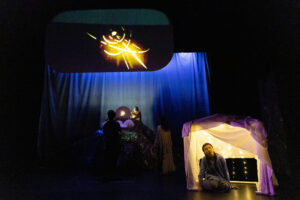
“What are we except the stories we tell ourselves?”
A little girl confined in a small space surrounded by white draping suddenly is visited by a fairy who beckons her to follow, leading Lyra into a supernatural domain and a journey full of wonder, excitement, and danger — a dreamlike journey in which she will eventually learn and accept an important, new reality. Her fantastical odyssey unfolds before us in captivating, enchanting, and oft-delighting modes in Conner Lifson and K. Sid Zhang’s Moonchild, now in a memorable, magical world premiere by Stanford Theatre and Performance Studies (TAPS).
Lyra finds herself in a world where water is no longer, where lands are desert terrains, and where the Sun scorches all as she makes her daily passing across the skies above. That same Sun appears before Lyra and tells the child how her sister, Moon, has disappeared, taking with her the cooling, nightly rays that once relieved the world below from the Sun’s life-giving yet fiery, daily radiance. Sun appeals to Lyra to go find her sister and convince her to return in order to restore the parched environment. “The planet is ill, and perhaps you will find a way to heal it.”
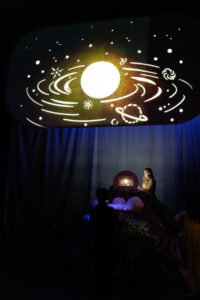
The Sun further explains that to find Moon, Lyra must make her way over the land now called “Moonfall” — a vast landscape where those living there are barely surviving but are doing so with daily hopes the Moon will return the next night. The Sun says that as the fairy guides Lyra on her way, the young girl will learn the many symptoms suffered by the ill planet, including hearing an ongoing cry of “I’m thirsty.” “And so you are, Lyra,” the Sun warns, “but the world cannot spare a tear for you to drink.”
With a child’s eyes full of excited anticipation and readied spunk to plunge ahead, Lyra sets off following the light of the fairy. Melody Ding captures wonderfully the zeal, stubbornness, and in-born bravery of a girl of ten who does not yet know enough to fear going where those her elder would never venture. That she is soon flying among clouds that she can then actually walk across, that she traipses across treacherous deserts and through dark and scary forests no longer with green leaves, or that she suddenly lands on the back of a giant Sky Turtle — these are just part of her mission to find Moon and to rescue the world as she has been directed by the Sun. Given Melody Ding’s contagious sense of youthful acceptance and excitement of whatever she encounters in this world she traverses, we readily become her willing and believing co-travelers.

But our own spellbound and almost breathless fascination following Lyra’s journey also comes from the bold, imaginative, and even childlike decisions Director Conner Lifson and his immensely talented creative team have made how to convey Lyra’s story. Constantly present but almost unnoticed is Iok Kei Kevin Chen intricately and artfully filming close ups that project on a large screen above the action and/or on a smaller screen at the apex of a mountain dominating center stage — just one part of Bren Kekoa Bartol’s overall whimsical scenic design often employing materials from crumpled cloth to stacked netting to miniature sets that explode in projection to become detailed, full-size wonders. Trekking across a desert is conveyed by Lyra’s blue-inked fingers projected gigantically across the screen — fingers that take on their own personality and clearly convey their own storyline apart from the narrative we hear.
Fingers walking across an actor’s bent body on his green shirt or hopping across red puffs of cotton-like material become eye-popping vistas on the screen above, with our continuing to bat our eyes between the action on stage and the screen itself. Hands and fingers become creatures Lyra encounters while projected scenes emitting from tiny structures on stage become real, fascinating, beautiful, and even spine-chilling.
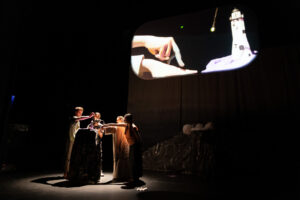
Much of the allure and intoxication — as well as the mystery and the thrill — of all these scenes is due to an intricate and multi-faceted lighting design by Raina Yang, with pinpoints, streams, and brash explosions combining with dark and shadow to create worlds both on stage and in projection cinematic in nature. An ongoing sound track of effects designed and music composed by Eito Murakami greatly enhances the otherworldly atmosphere as well as the rollercoaster of emotions emerging from the story’s developments. Delicate, delightful shadow puppetry designed by K. Sid Zhang is a further ticket to our entry into this world of a little girl’s imagination.
The regal elegance of a commanding Sun along with a sense of helplessness in being able on her own to find and lure her Sister Moon back into the night sky is convincingly and confidently portrayed by Rachelle Weiss, who also serves as Narrator of the evening’s tale. A lighthouse with a seafaring manner and a lilting accent of Irish-like origin is wonderfully played by Lauren Thompson with the tall Lighthouse providing Lyra the direction to proceed toward an horizon where the Moon was last seen by Lighthouse.
Henry Cargill is hilariously lovable as a gravelly voiced Sky Turtle on whose back Lyra at one point lands; together they traverse on a wild and bumpy flight across the skies from east to west, the journey again captured so magnificently both on stage and simultaneously in projection. When sent by the Sun into dark, underground tunnels to a place Sun says her sister hides, Lyra comes face-to-face with Monster (Jahfari Maddo), who opens up a set of hard-to-face realities to Lyra with a voice and manners that switch from initial harshness to that of near-sweet and understanding compassion. Each of the characters portrayed is given added definition and personality through the ingenuous costumes designed by Ezra Melosh.
Lauren Thompson, Henry Cargill, and Jahfari Maddo also portray other roles and most impressively, become landscapes, trails, cloud conveyers, and much more with ever-present, on-stage bodies that bend, slide, extend, and shift under the movement advisement of Sid Zhang.
A fairytale-like story that we watch with our own childlike wonder — much like those tales we were once read when young — takes on a surprising and unexpected turn, although looking back, many clues along the way indicate where this journey will end for Lyra. The result is a tale that takes on heart-touching twists and turns that will likely draw a tear or two as well as leave one with a sighing smile.
Connor Lifson & K. Sid Zhang’s Moonchild is a world premiere with much promise for a future beyond its initial Stanford TAPS staging — a beautifully conceived and crafted tale of hope for what lies out there somewhere in Moonfall for each of us as we live out the stories of ourselves.
Rating: 4.5 E
Moonchild continues through May 9, 2026, in a ninety-minute (no intermission) production by Stanford Theatre and Performance Studies (TAPS) at the Pigott Theatre, Stanford University, 550 Memorial Way, Stanford, CA. Tickets are available at https://taps.stanford.edu/events/.
Photo Credits: Frank Chen & Kelvin Niu

Leave a Reply