
Oy! What They Said About Love
Steve Budd
The Marsh San Francisco

Steve Budd is turning fifty and has yet to meet his ‘beshert,’ his soul mate for a life of bliss together after their exchange of vows under the chuppah. Sure he has dated a string of possibilities along the way, but none of them seems ever to work out. What is going on? In his created and performed solo show, Oy! What They Said About Love, now in a premiere production at The Marsh San Francisco, we get a pretty good idea why this guy has struck out for so long. In what is billed in the program as a “relentless, heartfelt, and hilarious search” for “the one” unfortunately turns out to be mostly “relentless” in a seventy-minute show that seems to drag forever with little spark and with only occasional, lukewarm humor.
Steve recounts how on his fiftieth, he gives himself a present by heading to Oaxaca, Mexico for a vacation that he had been putting off for years, always hoping first to meet someone special to go with him. There he meets on a blind date thirty-two-year-old Chinua, a “beautiful, bright, bubbly” Kenyan with whom there seems to be some immediate spark.

As he begins to spill details of their first encounters, he interjects short snippets of interviews he had done with two married couples — friends of his — whom he spent several hours exploring how they met, their ups and downs in the relationship, and their advice how to make a marriage work. Matt and Gaby are both Jewish; Sarah and Connor are an interfaith couple, but one with Connor accepting and even pushing Sarah to increase her Jewish practices. As we listen to Budd, meeting someone Jewish as his “beshert” seems both a goal but also a question mark for him, since it seems every Jewish woman he has met in the past reminds him too much of his mother, sister, or cousins — and that, he admits, feels “incestuous.”
So finding this Kenyan woman who quickly seems ready to get serious sends Steve’s mind racing toward a possible date under that desired chuppah — after first following the Kenyan tradition of giving a cow and two goats to her home village — and he begins to rationalize that even if Chinua is not Jewish, “God will understand.”
But we soon learn, once Chinua arrives for a visit in the U.S. after a month of their Skype conversations — “the most romantic month of my life” — it takes only their first few hours in his apartment for Steve to begin nitpicking. After all, who wants bits of parsley and flour on the kitchen floor (even if the resulting meal is delicious) or small plastic tags from new clothes bought messing up the place? And what’s with someone like Chinua liking to watch “Urban Housewives of Beverley Hills?” I mean, Yuk. Can that be part of “beshert”?
So begins a rollercoaster of a journey for Steve and Chinua with constant pauses along the way to hear from Matt and Gabby, Sarah and Connor, and Steve’s Jewish Mom, who is set on his finding a mate as soon as possible. In the typical fashion of Marsh solo shows, Budd takes on the persona of each of these people — including of course Chinua — and in the usual Marsh experience, we as audience should be enthralled, engaged, entertained, and maybe even educated.
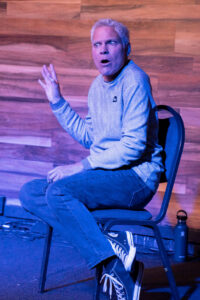
However, this solo show generally fails to reach those Marsh standards. Budd’s storytelling rarely compels us to lean and want to learn more. The intermittent interviews that bat back and forth between the two chairs on the bare stage introduce people who are quite one-dimensional in the performer’s depictions. Their postures do not shift beyond feet sprawled or legs tucked off to the side; their mannerisms like lightly stroking a chin stay the same throughout; and their various voices are not that engaging or differentiated even from his as narrator. Even though these are supposed to be video clips we are watching, if the interviews we watch are culled down from those interviews of several hours, the people it seems would show much more variation than what we are witnessing. And for the most part, what we hear from the couples is often too short for us to make a connection that holds our interest and attention as well as often to ascertain what is the real point of the portrayed fragment.
Most of his depictions of Chinua are of a young woman slightly bent forward, who has a voice less Kenyan accent and more just high squeak, and who tends to clap her hands a lot while smiling a quirky grin. That chosen representation by Budd just does not feel that comfortable to watch. There is an urge to look away and an unease not dissimilar when Budd choses to tell a questionable joke about “four Jewish women.”
Steve Budd also sprinkles throughout his own love of Jewish traditions like lighting Shabbat candles and attending Friday night services — including bits of loud singing of familiar Jewish songs/prayers — but even that thread of his narrative seems to lose its way in leading him or us to a conclusion where there is a learning, an important ah-ha, and most importantly, some decision for real change.
In the end, the actor I have seen and much appreciated in the past on a number Bay Area stages in this particular outing failed to win me over. The tepid response with only an occasional mild chuckle from the small audience at the performance I attended seemed to mirror my and my companion’s oh-hum reactions to The Marsh’s production of Steve Budd’s Oy! What They Said About Love.
Rating: 2 E
Oy! What They Said About Love continues Saturdays at 8 p.m. through June 6, 2026 in a world premiere production by The Marsh San Francisco, 1062 Valencia Street, San Francisco. Tickets are available at http://themarsh.org.
Photos Credit: Michael Prine, Jr.
