
La Cage Aux Folles
Harvey Fierstein (Book); Jerry Herman (Music & Lyrics)
Theatre Rhinoceros
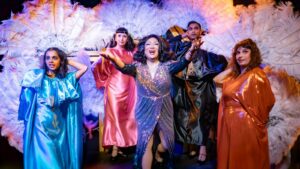
Anyone preparing for Pride and searching shops around the Castro for a yard or two of chiffon, silk organza, netting, voile, or gauze much less any spangles, sequins, boas, or feathers might as well give up. Bonita Rose has probably emptied most shelves as she acquired all such items to dye in all colors of the rainbow before she stitched together a slew of glittering, gaudy, gorgeous (and often hilarious) outfits to be worn and changed in the blink of an eye for Theatre Rhinoceros’ currently running La Cage Aux Folles.
The only musical ever to win two Tonys for Best Revival of a Musical as well as its original, 1984 Tony for Best Musical, La Cage Aux Folles may now be on the tiniest, most intimate staging in its now long lifeline of productions worldwide. With less than thirty in a sell-out audience, The Rhino’s La Cage where actors are mere inches from the two rows of audience members feels like being in a back-alley New York or Berlin space where a forbidden show is being secretly produced.
In fact, when it first opened in 1983, Harvey Fierstein’s (book) La Cage Aux Folles did break many barriers, being the first Broadway musical to portray openly and proudly a gay, romantic relationship. Maybe it is appropriate in this era of rising anti LGBTQ threats of Trump’s 2026 that The Rhino’s production does have that forbidden feel of a venue. Now more than ever, The Rhino’s production of Harvey’s story (based on the 1973 play by Jean Poiret) and the music/lyrics by Jerry Herman importantly titillate, entertain, and declare proudly a message important for all to hear: “I Am What I Am.”
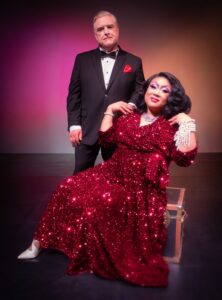
Master of Ceremonies, Georges, welcomes us as audience, pointing out some with his big smile greeting of “so many old friends, so many new faces, so many old friends with new faces.” He is soon joined on the stage by four “women” pulsating tantalizingly their feathered fans in his St. Tropez, drag nightclub, La Cage Aux Folles (translated in English as “The Cage of Crazy Women” with “folles” also being French slang for an ‘effeminate, gay man’).
Missing from the stage is the featured star of the club, Zaza – the stage name of Georges’ long-time partner in business and in life, Albin. Albin is in their shared apartment, “wrestling with a casserole” and dramatically sulking because Georges has refused to allow him to revive on the La Cage stage his Salome with her dance of seven veils. After Georges capitulates, we watch through the invisible mirror of his dressing table Albin transform into the magnificently and flamboyantly attired Zaza in one of her many magnificent wigs. We also are introduced to Zaza’s guttural, husky vocals smoldering with powerful passion as Christopher Juan (aka Chi-Chi Kago) sings “A Little More Mascara.”
Throughout the show, Chi-Chi Kago’s Zaza and Albin personas will dominate the stage each time either appears or when Albin shows up metamorphosed as straight-acting “Uncle Alber” — or as straight as he hilariously can be — or as Georges’ wife, the conservatively dressed and properly mannered “Sybil.” But when Zaza brings Act One to a close with the song that has become the official/unofficial gay anthem, “I Am What I Am,” Chi-Chi Kago creates a Zaza moment that is moving, full of conviction, and exploding in deep-felt pride.
Albin is called upon to be someone other that his deliciously effeminate self because the twenty-four-year-old son whom he raised like a mother, Jean-Michel, is bringing to his and Georges’ home his bride-to-be along with her ultra-conservative, anti-gay parents. Jean-Michel asserts that he cannot have Albin swishing around in lace and heels, eating his toast with a raised pinky, or talking in a voice that roams from bass to soprano in one sentence.
Albin is of course hurt beyond words. Well actually, when Georges asks him to absent himself from their home for one day, Albin does have a lot of words to say before dressing himself from head-to-toe in fashionable, mourning black. It takes a walk on the beach and Georges’ “Song on the Sand” to convince him to do this one thing for their adored Jean-Michel.
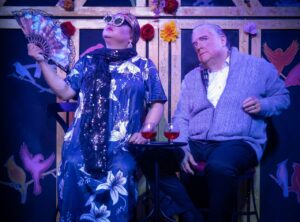
It is Georges’ “Song in the Sand” when we especially get to appreciate the heart-warming, solid-sound voice of John Mannion. Well-cast as Georges, Mannion portrays with much style and grace a man full of compassion and understanding for both his son and his partner yet also showing moments of impatience and exasperation with both. His pleasing vibrato-laced “With You on My Arm” and “Look Over There” give him opportunities to establish quite clearly that at its heart, La Cage Aux Folles is a love story between two men who have grown into one entity through a life-time together at a time when being such a couple was risky – even in the overall liberal-minded France.
As Georges is balancing the needs of a son who does not want to be embarrassed by his too-feminine “mother” Albin and those of that “mother” who has lovingly raised the boy since his birth mother is a no-show in his life, into scene after scene pops the fourth member of this household; and each time ‘she’ appears, we cannot help but laugh with delight.
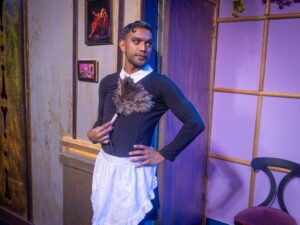
SNJV is rib-tickling funny as Jacob, the household’s “butler” who decided long ago instead to be a “maid.” Each time SNJV edges her way into the middle of whatever is going on, it is with huff, puff, and pizzazz and always in yet another outlandish costume. With incredibly long-lashes fluttering, toes twinkling, and facial expression that can switch in the twist of her head or hips from full-on shock to pitiful hurt to devilish impishness, SNJV as the proudly effeminate, and unabashedly “out” servant repeatedly defends with snarling snit Albin’s fits and fickle to an oft-exasperated but loving Georges.
Most members of a cast that is much smaller in number than most La Cage productions play two or more parts, with most finding their own moments to shine forth. SNJV doubles as member of the Les Cagelles chorus line, bringing more of their drag glitz and glitter into full play. Natalie Harris (an under-study for the normally performing Chloë Angst) is also a hilarious member of the chorus line — a whip-carrying, S&M-loving German named Hanna — as well as a famed Paris restaurant proprietor named Jaqueline who joins Albin and the entire company (and a few audience members) with her full-on soprano in a crowd-pleasing “The Best of Times.” Sidney McNulty is chorus-line member Babette; a doting and dear Madame Renaud; and the dreaded, future mother-in-law, Marie Dindon, who undergoes a funny but inspiring conversion from bigot to supporter that is one of the musical’s important, underlying messages: ‘once they know us, they will support us.’
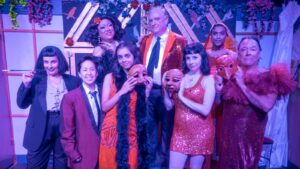
Akhila Narayanan is the fourth chorus girl, a sweetly voiced Chantel, as well as Jean-Michel’s intended, Anne Dindon. Mark J. Enea is the La Cage stage manager whose increasing injuries are due to his becoming more and more serious in relationship with hard-hitting-in-love Hanna; he is downright mean and nasty (which means he is a good actor) as the right-wing-fanatic father of Anne, Edouard Dindon.
A clever touch by co-directors Crystal Liu and John Fisher is to have the Dindon family appear at a meet-the-in-laws dinner party in half-faced, big-cheeked, leather masks — Pulcinella masks from Commedia del’arte theatre — which only show their mouths and chins, leading to hilarious interactions as especially the father rails against gays looking totally ridiculous.
A big disappointment of the evening that results in the overall show’s impact being much less than it could be is the casting of Jean-Michel. Unfortunately, the actor is never able to sing with a voice compelling or loud enough to allow critical moments to convey the meaning the script demands, and even the actor’s ability to sell his part when speaking just does not work overall. It seems he was chosen because of a curious inclusion by the co-directors of scenes with an aerial hoop where the actor uses his bare feet to climb, spin, and hang upside down while his betrothed Anne is sitting on the ring. Those scenes frankly did not seem to fit that well, in my opinion, into the overall production, and certainly are not worth the cost of placing greater priority on an acrobat than on an accomplished singer.
But that one major flaw aside, Theatre Rhinoceros is to be commended for undertaking the production of a show that normally is seen on vastly bigger stages and with much larger casts. There is indeed much to enjoy in this intimate visit to La Cage Aux Folles.
Rating: 3.5 E
La Cage Aux Folles continues in an extended run through June 14, 2026, in a two-hour, thirty-minute production (one intermission) at Theatre Rhinoceros, 4229 18th Street, San Francisco. Tickets are available at https://www.therhino.org/.
Photo Credits: Scott Sidorsky.
