
Doubt
Douglas J. Cuomo (Composer); John Patrick Shanley (Libretto)
Opera Parallèle
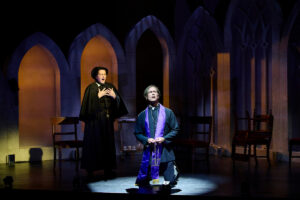
A rigidly traditional nun’s vague but deeply-felt suspicions about a modern-leaning, charismatic priest’s inappropriate conduct with the first black student in a 1964 Bronx Catholic school is the subject of John Patrick Shanley’s much-acclaimed Doubt: A Parable, winner of both the 2005 Pulitzer Prize for Drama and the 2005 Tony Award for Best Play. The playwright went on to produce both a film and an opera that continue to explore themes of certainty versus doubt and the clash between tradition and progress, expanding the original four characters to include a host of others. Now Opera Parallèle opens a world premiere chamber opera by John Patrick Shanley (libretto) and Douglas J. Cuomo (composer), returning to the original play’s four characters and minimalist structure in a Doubt that is intensely engaging, musically astounding, and emotionally gripping.
And most importantly, in a story in which serious accusations are made with no concrete proof and in which there are hints and clues sprinkled throughout that suggest both possible guilt and possible innocence, the creators, conductor, and director of Opera Parallèle’s Doubt have taken special efforts not to tip the balance one way or the other by the opera’s end. We as audience are left with the opera’s own embedded doubt, with the discomfort of not knowing, and with the decision whether to decide guilt versus innocence or to live with not having that certainty. In this day and age of a largely split society where everyone is so rock-hard sure about everything, the powerful message of Doubt is that we can be open to the possibility of not always judging too quickly and of being more comfortable just listening to our hearts and our guts a bit longer before letting the mind take over.
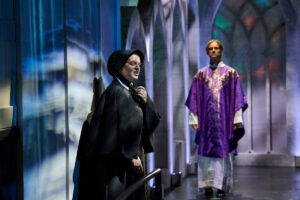
Father Flynn lays it our for us in the opening line of the opera as he preaches to us, the congregation: “What do you do when you’re not sure?” As Sister Aloysius listens intently on the side in shadows, already she is picking up hints that his sermon may be more for and about himself than anyone else. After all, she is clearly raising eyebrows when he makes certain observations in the context of the entire sermon: “No one knows when I’ve done something wrong” and “For those afflicted, only God knows their pain.” After approaching us up close and telling a story of a lost sea captain and his doubts when he could no longer see his way, Matthew Worth sings in an inviting, cogent, and soothing baritone, “Doubt can be a bond as sustaining as certainty … When you are lost, you are not alone.”
For her part, Rhoslyn Jones employs her uniquely toned, immensely striking soprano voice as Sister Aloysius immediately reflects alone on the Father’s sermon, “Something obscure, there was something obscure.” With notes that slowly slide from one to the other as lights swirl in waves all around us, she asks herself (and us), “What do you do when you’re not sure?”
What this senior sister and principal of the school does decide to do given her unsurety is to call in one of her teachers, Sister James, and begin an inquiry about her students, leading to ask with cocked head specifically about twelve year old Donald Miller, the only Black student. She then wonders why Father Flynn sermon chose to speak on doubt, obviously attempting to plant in Sister James’ mind what she hopes is a seed. With notes that increasingly intensify, she sings, “Something is either true or not true, and the truth will find us if we stand still with eyes unblinking,” with the sung word “truth” taking on a sustained, foreboding life on its own.
As that point sinks in and the two leave, a viola player emerges with a song of its own uneasy and unsettling — just one of many times during the evening the composer calls on individual instruments and the entire orchestra to intone their own words and warnings, sensations and sentiments. Under the astute and sensitive direction of Nicole Paiement, the orchestra in fact is often the fifth character with a clear voice of its own.
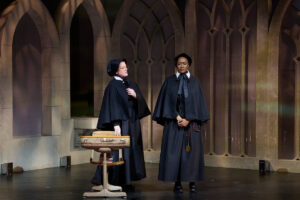
The intrigue of an opera that is more like a play set to music continues to increase in a second meeting between the sisters when Sister Aloysius now presses Sister James to tell her about Donald Miller’s being called out of class by Father Flynn with no explanation before or after. When she learns from a somewhat reluctant Sister James — who often looks herself like a guilty student called into the principal’s office — that upon returning to class Donald had an expression she could not understand and also alcohol on his breath, Sister Aloysius is ready to go into a full-gear investigation on her own, ignoring the normal Church protocols to go up the male hierarchy which she clearly does not trust.
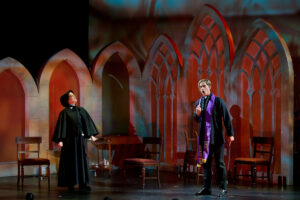
A confrontation meeting with the Father — one in which Sister James is compelled by her superior to be included — begins first innocently as a Christmas pageant planning session but soon becomes pointed questioning and out-right accusations. The piercing brilliance with blade-sharp exactness of Rhoslyn James’ sumptuous soprano articulates Sister Aloysius’ step-by-step plan to get a confession that the shocked and increasingly angry Father has no intention of giving. The powerful vocals of both soprano and baritone explode into the air as the tension increases and the orchestra responds.
For her part, Sister Joyce is not buying her principal’s attempts to accuse whom she sees as a caring priest who is just trying to help a boy — one beaten at home by a brutal dad and one vulnerable to bullying in a school of all whites in a time when America’s cities are on fire with race riots. Naomi Steele sings with commanding, compelling vocals full of arresting clarity, “You just don’t like him … and you’re letting that convince you,” adding with a courage suddenly sprung from her own sincere beliefs, “And it would be nice if this school were not run like a jail.”
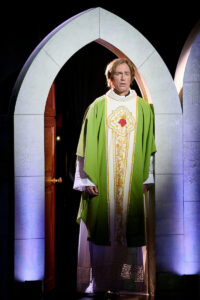
A sermon by Father Flynn about “a woman [who] was gossiping about a man she barely knew” only adds coal to the fire and Sister Aloysius’ burning desire to find a way to rid the school of what she believes is a threat to the well-being of the students. Her investigation leads to her calling in Donald’s mother to see if she has evidence to add to the Sister’s suspicions.
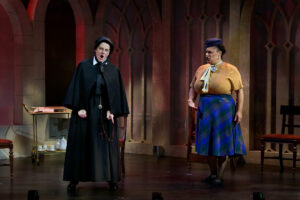
As Mrs. Miller, Deborah Nansteel rich, powerhouse mezzo-soprano makes it clear that her son who has a “special nature” and who is beaten by his father because of how the father sees him as different, that this son “needs some man to care about him” like Father Flynn. With resolute, deep-felt notes and an expression of a mother’s firmness even as she faces eye-to-eye this white nun and principal, Mrs. Miller sings, “And thank God this educated man with some kindness in him” wants to help a son no one else — friends or father — likes.
The stage is now set for an opera’s ensuing scenes leading to one where strong-willed voices will resoundingly shake the rafters and shatter any hope of mutual resolution as accuser and accused finally meet in a climatic confrontation. I personally cannot remember when I have been so drawn into an opera’s story with my own palms sweaty, my heart pounding, my eyes glued forward, and the hairs on my neck erect. While I was so sure several times during the two hours prior whom I believed, I found myself in these tumultuous moments full of … dare I say it … doubt.
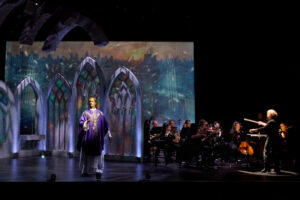
Beyond the mind-blowing, combined impact of a magnificent score, stellar acting, and world-class vocals, Opera Parallèle’s Doubt is visually breathtaking. Jacqueline Scott’s designed set of cathedral-like arches hug the set’s curve, providing a palette for Jessica Ann Drayton to create lighting magic on and within the arches as moods and scenes shift. Drayton’s total lighting scheme takes on time and again a starring role in the evening’s luster; but it is also her projections that emerge from a large backdrop to seep deep down both sides of the audience that allow a church’s interior, a classroom, a gym, and numerous outdoor scenes of trees and snow to come alive around us.
Y. Sharon Peng — as she is wont to do on many Bay Area stages — makes important statements that add to the story’s intentions through her costume designs. A priest who is advocating being more like family with his congregation and meeting people where they are has argyle socks peeping out from his a-bit-tight-and-short (in a 60’s kind of way) black pants while his priestly coat sports stylish suede patches on the sleeves. What a contrast to Sisters who are in extremely, traditional, ankle-length habits with black bonnets tied tightly on their heads.
Final kudos goes to Brian Staufenbiel whose creative directorship has assured a fast-clipped pace, moments of quiet transition between oft-tempestuous-ending scenes, inclusion of us as audience as yet another active character in the opera (students, congregation, judge and possible jury), and a thoroughly balanced approach so that we can make our own decisions — or not — of who is right and who is wrong.
The tragedy is that this stunning, singularly memorable world premiere production will soon be history after only one weekend. My sincere hope is that an opera that should be attractive to lovers of live theatre of all sorts — plays, musicals, and operas — will find many more companies across the country and globe ready to place Doubt high on their wish-list.
Rating: 5 E
Doubt continues May 30 and 3, 2026, in a two-hour, ten-minute world (one intermission) premiere production by Opera Parallèle at Presidio Theatre Performing Arts Center, 99 Moraga Avenue, San Francisco, CA. Tickets are available at https://operaparallele.org/.
Photo Credits: Stephen Cohen
