
Macbeth
William Shakespeare
Modern Translation & New Version by Migdalia Cruz
Magic Theatre, in partnership with Play On Shakespeare

In a dark, dingy subterranean world where the sounds of New York’s traffic and sirens shatter a steel and concrete atmosphere peppered sporadically by a passing subway’s overhead lights, a kingdom of street-trained goons with their knives and bats rule with their own established hierarchy of military and royal titles. While far from the green hills of Scotland, Migdalia Cruz’s new, modern translation of William Shakespeare’s Macbeth still retains all the geographic references of the original — a sign this dystopian world images itself much grander than is its filthy reality. In partnership with Play On Shakespeare, Magic Theatre opens Cruz’s gut-punching, gripping, yet still poetic Macbeth. The result is a stunning, surreal, and oft-startling world premiere under the mighty and masterful direction of Liam Vincent. With a cast whose portrayed characters are universally know, this group of principals may rarely have been portrayed with such biting grit, grime, and grief.
Unlike Shakespeare’s mostly all-male universe, in this 1970s setting when in the unseen world above women were demanding their equality, the women below overall rule and command with ruthless spit and spite a world of metal pipes, graffiti, and flickering florescence. With a face hardened by past battles and a stony, inbred disposition, Catherine Castellanos’ Macbeth is a woman no one would want to confront alone on a dark alley. Her gruff-voiced, Brooklyn-street accent evokes the rhythms and artistry of the Bard and of Cruz, preserving and even enhancing the metaphoric brilliance as originally conceived by Shakespeare in a modern interpretation that makes her lines even more impactful for a 21st century audience.

As Macbeth’s fated arc from sudden dominion to surprise demise quickly lurches forward, Catherine Castellanos demands our transfixed gaze. Often speaking with eyes lowered or even closed, when she does raise her sight to shoot a stare, that deep-set, black-lashed-and-browed stare pierces the atmosphere — sometimes in murderous determination, sometimes in sheer and crazed fright.
After she ensures the bloody end of visiting King Duncan, her entire body vibrates as she recites in horror to her wife a voice she keeps hearing with its “Sleep no more, sleep no more.” An epileptic, screaming fit when she sees the slain Banquo’s blood-spattered ghost, followed by a ripping “Go, go, go” to the smirking specter is just one of a number of times when this Macbeth sends shudders down our spines. Castellanos’ Macbeth is an underground thug who thinks herself worthy of the chain of her region’s command but soon finds herself choking in horror under the weight of her deadly actions to gain that rule.
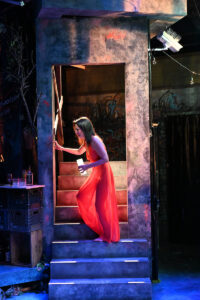
If not for her wife, maybe even this power-thirsty Macbeth would have been satisfied just gaining the sudden title of Thane of Cawder. However, the Lady Macbeth in her leopard-spotted, skin-tight gown is a predator whose own ambition is not about to be thwarted by a hesitant spouse’s sudden second thoughts. Lady Macbeth’s reading a letter about her husband’s recount of the witches’ predictions is marked by an immediate, demonic plotting as she slashes her rigidly pointing fingers through the air, screaming her own ideas of doing what it bloody takes to become that very night a queen.
Sarah Nina Hayon reigns supreme with sleaze and shameless vile each time her Lady Macbeth emerges from the shadows of the underground’s passages or stairs. She becomes unearthly as she sits on spread knees before a burning candle and vows with eerily intense face, popping eyes, and hands now like a cat’s claws, “Unsex me here, and fill me from head to toe, full of direst cruelty.” As deadly deeds mount, she dresses in red, sipping wine of the same color, full of sinful satisfaction. But when her own guilt overtakes her being, we witness a mad woman’s ranting in her sleep as she attempts to wash away the unseen blood that she can no longer rid from her now crumpled hands. Sarah Nina Hayon provides a host of memories seared into our minds of what true evil looks embodied in a person as much animal as human.
In her role as the loyal friend and cohort who is with Macbeth when the witches inject both with promises of future greatness, Nora El Samahy’s Banquo is much the calmer and more cautious of the two upon hearing the news, quickly suspecting, “It is strange how often that to lead us into dire harm that the dark devils and demons tell us truths.” How prophetic Banquo is as she herself will become a victim of Macbeth’s drive for a lasting dynasty, and how haunting are the stares of her returning from the dead as a ghost that scares away any hope of sustained sanity for the new king. Nora El Samahy also takes on other ensemble roles including as the attending Doctor who tries to comfort the spastically trembling, vein-popping Lady Macbeth as she cries trying to scrape the “damned spot” from her hands.
Donning her NYU cap, Kina Kantor is a preppy dressed Malcolm, offspring of the ill-fated King Duncan (the latter played by Brian Rivera, also in the role as the street-smart messenger, Ross). Kantor’s mild-mannered Malcom will eventually rise as an angry warrior to rid the underworld of the regicide Macbeth. Kantor also doubles in roles as the distressed Lady Macduff who wonders in vain why her husband has abandoned her, soon to watch in screaming horror as her own child (Isabella E. Lowry) is brutally stabbed before she herself is hauled away to be dealt the same blows.

Juan Amador is the smug, smooth-talking Macduff — a street-and-alley roamer who speaks from the side of his mouth with the sound of lower East Side. In some part of these tunnels under New York that is denoted by this gang as England, Macduff has gone to fetch back Malcolm so they can together avenge Duncan’s death, only to hear of his own wife and children’s bloodbaths. Macduff’s initial stunned shock followed by the anguished cries of a husband/father’s agony are in great contrast to Juan Amador’s ensemble role as the a slump-shouldered, slimy murderer of Banquo.
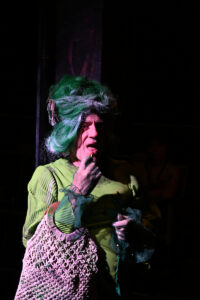
Even in a tale as tragic and blood-filled as this, Shakespeare (and thus also Migdalia Cruz) always finds ways to lighten up the darkness with pun-filled and often riotous humor. Who better to fulfill that role in this Magic retelling than Bay Area’s favorite comic genius, Danny Scheie. As the Porter who is responding to a midnight’s thunderous pounding of knocks upon a gate, Scheie is a wild-haired manic of fun as he rattles off a list of possible intruders (“Beelzebub,” “a greedy farmer,” or “Deadly Sin”). Breaking the fourth wall to sit with the audience as he rants and thrice engaging us in “knock-knock” jokes to surmise who it might be, his Porter is only bested by Scheie’s green-dressed-and-wigged Witch (one of the three sinister sisters, played by equally wild and weird Kina Kantor and Juan Amador). Each of the Witches becomes hilarious explosions of screeches and squawks as they conjure up their predictions, with all three also going into shaking, spastic trances to deliver their final, false assurances that Macbeth’s reign is safe since forests don’t walk and any potential murderer must be woman-born.
While these are all stellar performances long to be remembered, it may be the special effects created by Magic’s designers and instrumented so spectacularly to bring the director’s vision to life that will especially be most recalled with awe. Even in the intimate space of Magic’s theatre in which a near-by audience surrounds the floor-level stage on three sides, the underworld of New York designed by Carlos-Antonio Aceves feels cavernous. Pervasive pipes, steps of metal and concrete, and scores of bags ominously stuffed of unknown contents perturbing from holes and corners become a palette for the lighting of Justin Partier to spot and splash both bright harshness and sudden colors of creepy green or bloody red. The demon face of an assassin ascending the steps to Duncan’s bedroom is lit with a tone that sends chills — just one of dozens of examples when a lighting choice adds a volume of enhanced meaning into a scene’s passing moment.
Likewise, the sound design of Matt Stines time and again establishes the urban setting we cannot see of traffic, sirens, bells, and trains as well as helps turn a concrete hellhole into a disco hall as the Macbeths strive for a minute to ignore their dastardly deeds and party with drink and dance. From leather to silks, denim, torn nylons, and flimsy see-through nets of cloth, Alina Bokovikova costumes with vigor this bizarre collection of royal hoodlums and gutter creatures.
Shakespeare’s Macbeth has never been a feel-good outing of theatre in any of its thousands of productions these past four-hundred-plus years. Yet, the power of its message of unchecked ambition, moral decay, and resulting dismantle of political order has never been more timely or more of a must-see than this riveting, world-premiere adaption of Shakespeare’s Macbeth by Migdalia Cruz, Magic Theatre, and Play On Shakespeare.
Rating: 5 E, MUST-SEE
A Theatre Eddys Best Bet Production
Macbeth continues in extension through April 12, 2026, in a ninety-five minute (no intermission) world premiere by Magic Theatre a co-production with at 2 Marina Blvd., Landmark Building D, 3rd Floor. Tickets are available online at https://magictheatre.org/, by email at boxoffice@magictheatre.org, or by phone at 415-441-8822.
Photo Credits: Jay Yamada
