
La Belle et la Bête (The Beauty and the Beast)
Philip Glass, Based on the Film by Jean Cocteau
Opera Parallèle
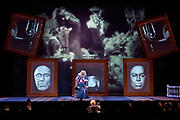
Fantastically blurring live stage performance with cinematic screening where reality and surrealism blend into an evening of spectacular entertainment, Opera Parallèle presents Philip Glass’ 1994 opera, La Belle et la Bête (The Beauty and the Beast) while also screening the 1946 film by Jean Cocteau of the same title. Four accomplished voices sing in incredible synchronization the lines spoken by the actors of Cocteau’s acclaimed film, each appearing on stage from time to time as their live-actions mirror what is also seen on screen. As a live orchestra mesmerizes the audience with its exquisite rendition of Glass’ captivating score that beautifully and thrillingly describes and supports the action and emotions of both film and stage, Opera Parallèle’s La Belle et la Bête becomes a sensory wonderland of sight and sound like nothing probably most audience members have ever experienced at an evening of opera.
Based on a 1757 story from a fairy tale anthology by Jeanne-Marie Leprince de Beaumont, Jean Cocteau’s Belle et la Bête is a story now universally known thanks in large part to Disney’s wildly successful animated film and subsequent Broadway hit, Beauty and the Beast. In some indeterminate ‘once upon a time,’ Belle’s father is sentenced to death for picking a rose from a garden of The Beast whose deep-forested castle the father has stumbled while lost. The Beast offers to spare his life if a daughter of the man agrees to come live with him.
While two sisters (who are not unlike Cinderella’s step-sisters in their shrewish demeanors) outrightly refuse, the sister whom they treat as a servant, Belle, agrees to go in order to save her father. What follows is a horribly disfigured, clawed Beast soon proves to have a soft heart and a gentle spirit for Belle. He repeatedly proposes marriage to Belle which she time and again refuses even as her own affection slowly grows for the outwardly ugly Beast. Their ‘happily ever after’ union does not occur before the Beast tests her love, almost dies in grief, and then is rescued by tears that prove Belle’s new-found love for him.
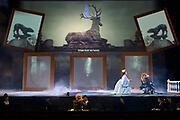
All of the above and much more plays out both in Cocteau’s black-and-white film shown on a large screen and in scenes shown on five, surrounding, picture-framed screens — two on either side of the center screen and three below. At the same time, actors appear from time to time on stage, with their movements timed impeccably to match what we also see on the big screen, thanks to the inspired imagination and meticulous attention of Brian Staufenbiel’s stage direction. The five smaller screens are often photos highlighting aspects of both seen and unseen parts of the film’s current scene while at other times show the stage actors filmed as if from the movie itself, all created by the director of projection and photography David Murakami.
The actors on stage become doppelgängers of the 1946 actors that seem as if they have stepped out of Cocteau’s film onto the live stage due to an out-of-this-world abracadabra achieved by costume designer, Natalie Barshow, and by hair and wig designer, Y. Sharon Peng. Especially jaw-dropping is seeing the stage’s Beast spotlighted via the lighting artistry of Jessica Ann Drayton and then looking up at the film’s Beast to realize that the two are twins — down to the last hair, threatening claw, and distorted wrinkle.
As Opera Parallèle’s Founder and Artistic Director, Nicole Paiement, conducts with palpable energy, engrossing intensity, yet obvious sensitivity a seven-piece orchestra that has the sound at times of seventy, the cast of four sing Glass’ libretto in an opera that is really an ongoing sequence of recitatives. As lips of the filmed actors move, Glass’ French libretto is sung often in near-perfect match (with English subtitles showing on the large screen of the original film). What is missing are the normal arias, duets, and other combinations of singers that one usually associates with operas. What we do hear is a running dialogue sung in stellar fashion and with emotionally impactful interpretations by the cast of four virtuoso vocalists.
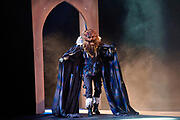
As the outwardly grotesque La Bête, baritone Hadleigh Adams reveals The Beast’s inner longing for understanding and for reciprocation of his love through notes often sung in vibrantly rich, soothing, and solicitous tones. Likewise, when in the role of her betrothed — local lad, Avenant– those same qualities echo from a lover whose prospects dim the more time Belle spends with The Beast. When the handsome face of Avenant and the inner soul of The Beast blend into Adams’ final depiction of Le Prince, his robust, noble, and caressing baritone vocals are a capstone for his evening’s performances of all three characters.
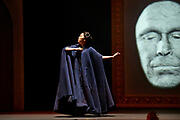
Chea Kang is a wonderful on-stage version of the 1946 film’s star, Josette Day, in the way she brings to life that era’s movie-style, exaggerated facial expressions of devotion to a father, fear of a perceived monster, and slowly unveiled caring for a Beast whose eyes give away his inner essence. With a soprano voice that can flow in a stream of rounded notes of crystal clarity and can also strike with an edge where a no means no to a proposal Belle is not ready to accept, Chea Kang reigns in presence and vocals as a princess in the making.
Showing a wide range of ways to express his impressive baritone is Aurelien Mangwa who sings the various personalties of Le Pére (Belle’s loving and aging father), Ludovic (her greedy and clumsy brother), and L’Usurier (a wicked and threatening usurer).
Often hilarious in mean-spirited, demeaning ways are Belle’s two sisters, Félicie and Adélaïde, both sung with mezzo-soprano spirit, gusto, and zing by Sophie Delphis in vocals often dripping in taunt and disregard and later in jealousy of their younger sister, Belle. Particularly fun is when Sophie Delphis appears at the same time in two of the projected frames as each of the two sisters — each with her own caricatured look and expressions and both singing the sisters’ lines in coordination to their counterparts on the original film’s big screen.
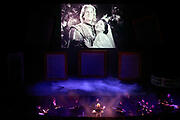
When finally the on-stage Belle and Beast become Belle and the Prince, the live actors fully populate on screen the final scene of Cocteau’s classic film — more of the magical genius of David Murakami and the transformative vision of Brian Staufenbiel in a true capstone of the evening’s blend of stage and cinema, of reality and surrealism. While at times the ninety minutes of the evening can be close to sensory overload and the sung dialogue can want for a bit more expansion and depth of sung character, the overall effect of Philip Glass and Opera Parallèle’s unique La Belle et la Bête is truly magical and very much a fairy tale that brings out the child in all of us.
Rating: 4 E
La Belle et la Bête (The Beauty and the Beast) concludes March 14, 2026, its too-short, two-night production by Opera Parallèle at Berkeley University’s Zellerbach Hall. Tickets to this and all CalPerformances at Zellerbach may be found at https://calperformances.org/.
For those unfortunately missing La Belle et la Bête, Opera Parallèle presents the West Coast premiere of Douglas J. Cuomo’s Doubt, May 29, 30, and 31, 2016 at the Presidio Theatre, 99 Morago Avenue, San Francisco. Tickets are available at https://operaparallele.org/doubt/.
Photos Credit: Stefan Cohen
