
All My Sons
Arthur Miller
Berkeley Repertory Theatre
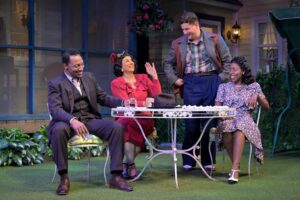
The American Dream: That illusive goal that so many have sought to reach, so many sacrifices have been made … often not for one’s own self but for the next generation so the lives of children will be better. A Dream supposedly open to all, but in reality, mostly available at best to those whose skin is white.
But what if seeking the Dream for the good of your family leads to errors made, those mistakes covered up, and lives of others hurt … or even lives lost? In his classic, 1946 play, All My Sons, Arthur Miller explores the consequences of how one pursuit of the American Dream leads to damaging lies, betrayal of friends and family, ever-seething guilt, and a conflict between what is best for family and what is morally right.
Berkeley Repertory Theatre re-examines this masterpiece of American literature by asking what happens when the seemingly successful pursuit of that Dream has been made by Puerto Rican Americans, especially in a post-World War II era when such success by a racial minority was generally impossible. What allowances, if any, can be given for a lie and a cover-up if the perpetrator is someone society already has largely written off and discriminated against? How much sin can be forgiven when all a father wants is for his son to be given a chance to succeed in a society that says his race and color can not, should not succeed?
While Arthur Miller’s script does not explicitly ask these questions, David Mendizábal forces us to consider them without one word altered from the original script by casting the playwright’s key roles with people of color, people implicitly part of the Puerto Rican migration to the Midwest in the first half of the twentieth century. With a cast and a production worthy of any Broadway stage, Berkeley Rep and David Mendizábal open an All My Sons that grabs, grips, and will not let go as we are captivated and challenged by a story in which our sympathies and empathies are put to an excruciating test.

All is abuzz in the Keller family when Ann Deever arrives in 1946 from New York City, a young woman who grew up next door and who was engaged to the Kellers’ older son, Larry — a WWII fighter pilot who has been missing in action for three years. The other Keller son, Chris, has invited Ann because the two have been secretly writing to each other for a couple of years; and he is now planning on asking her to marry him.
That proposal faces a couple of major roadblocks. Ann’s father, Steve — a former partner of Chris’s dad, Joe — is in federal prison for shipping faulty cylinders to the air force, leading to 21 pilots crashing and dying. That crime is one Joe was exonerated from because the day it happened, he was sick at home with the flu.
Ann has assured Chris she is not resentful of his dad’s freedom and her dad’s conviction because — given the deaths of the pilots — she no longer recognizes Steve as her dad. Further, Ann does not care when she hears that all the neighbors on the block still think Joe is also guilty. She, like Chris, believes in the court’s decisions about both Joe and her dad.
A bigger issue for the proposed marriage is that Kate Keller, Chris’ mom, insists that Larry could still be alive, having read articles that missing boys are still showing up from time to time across the country. She is convinced Ann is still in love with Larry and that deep in Ann’s heart, also still believes Larry is alive somewhere.
A third roadblock arrives via a phone call announcing a second visitor is on his way to the Keller household. George Deever, Ann’s brother and a lawyer, decided to visit their estranged father in jail that very day and has something he wants to tell Ann, especially before she marries Chris.
Such is the set up that is turned over to a stellar cast to play out all the twists and turns and subsequent consequences to occur during three, totally captivating, fast-paced acts of the two-hour, forty-five minute (one intermission) play.

Powerhouse stage and film couple in real life, Wanda De Jesûs and Jimmy Smits, headline this impressive cast of ten as Kate and Joe Keller. We first see Joe as an easy-going, big-hearted, sixty-ish guy who loves deputizing neighborhood kids like eight-year-old Bert (a delightfully ball of energy, Danyel Lacy, alternating the role with Oslezhe Gboligi-John Gregory Bramah), promising to jail in the basement any bad guys they find. Joe is quick to shadow box playfully his son, Chris, whom he lovingly and repeatedly tells that all he has achieved in building a successful, machine-shop company is for Chris’ future. Joe also clearly adores wife Kate, whom he is quick to waltz across the back-yard lawn and joke about her constant household diligence, laughing to Chris, “I get money, I get a maid, and my wife works for the maid.” While he supports Chris’ feelings for Kate, Joe tells his son, “You marry that girl and you’re pronouncing [Larry] dead [to your mom].”

Kate is the headstrong, anchoring force in the family, unyielding when it comes to the belief her son, Larry, is still alive. No matter who tells her otherwise — which Chris often does to her raised ire — she often paces in the night worrying about him, even after three years of no word. As Joe jokes, “She’s wearing out more bedroom slippers than shoes.”
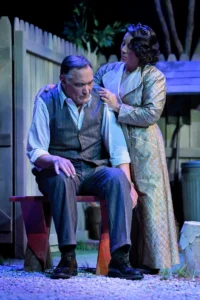
The interactions between Joe and Kate are made all the more palpable and often gaspingly gripping through countless ways the two glance at each other in knowing silence, look with both love and exasperation into the other’s eyes, cry out in a pain that is rooted in an unspoken something from years ago, or collapse in shuddering tears after a major eruption between the two. The exacting skills of two great actors are enhanced by the knowledge, intuition, and love resulting from their near forty years of relationship as life partners. Each actor also will leave us breathless more than once as the minutes pass to reach Joe and Kate’s individual, climatic revelations, admissions, and consequences.
Equally masterful in a myriad of ways are the performances of the couple-in-the-making, Alejandro Hernandez as Chris and Mayaa Boateng as Ann. Chris is seen by everyone as a near teddy bear kind of guy — one ready to give hugs, to uplift those around him, and to be playful at a moment’s notice almost as if still a boy. He also is exasperated with his mom for still believing Larry is alive (“It’s like being at a train station and waiting for a train that will never come in”) and is adamant that he will marry Ann, no matter what his mom believes.
Ann brings sunshine into the setting when she appears, exuding a spirit of carefree while also having a strong sense of what she believes and what she wants in her life … and she wants Chris as her husband and is willing to tell Kate in no uncertain terms her own belief about Larry’s fate. The trajectories that both Ann and Chris progress as events of the monumental, difficult evening unfold provide both actors ample opportunities to astound us with their wide range of emotionally charged expressions.

Brandon Gill’s George Deever plays a crucial role in an eventual spilling of long-held secrets. George arrives as a time-bomb about to explode as seen in gripped fists, a face tight as a snare drum, and eyes that are fiery. Yet the sight of an open-armed, big smiling woman who always treated him like her own son (Kate) and of a pal who was once like his brother (Chris) transforms him — at least for the moment — to someone now relaxed and once again at home — someone almost unrecognizable from the tinderbox of a few minutes prior. But his George is soon to continue being a rollercoaster of switching emotions, and Brandon Gill delivers with knock-out credibility the sudden transitions.
One of the reasons All My Sons is so engaging, believable, and often even funny (at least for a while) are the surrounding characters who drop into the inviting backyard setting of this attractive mid-century home (designed so beautifully by Anna Louizos to give us the feeling of a real community, one that could be in Any Town, U.S.A). Next door in the home the Deever’s once lived are Dr. Jim Bayliss — an oft-funny, hen-pecked husband who sees more than others realize, played by Cassidy Brown — and his wife, Sue — Elissa Beth Stebbins as a sometimes blunt woman who is not bashful to express to Ann her resentment of the “Holy Family” next door, especially of Chris whom she believes is leading her bored husband to be too idealistic.
Neighbor Frank Lubey (Brady Morales-Woolery) is a friendly jumping jack of energy who believes in astrology and thinks — to Kate’s relief — that he is on the cusp of discovering why Larry may be still alive. His always-cheerful wife, Lydia (delightfully played by Regina Morones), seems to arrive time and again just at the right moment to ease tensions with her bubbly personality.
The coming and going of these neighbors help us to see the Kellers’ home as an example of the All-American home so many strive to have, part of many people’s American Dream. But we cannot help but see — even from the beginning — that this dream may in the end be a nightmare. There is a tightness in Joe that belies his outward easy-going nature. There are ways Kate sometimes looks at him with eyes worried and a hand suddenly gripping itself in unspoken anxiety. Even Chris’ wanting to move away and start a own life on his own with Kate may be for inner, gnawing reasons that he may not quite yet understand. Such is the sheer strength of not only a timeless script but also a drop-dead excellent cast and director in Berkeley Repertory Theatre’s must-see All My Sons.
Rating: 5 E, MUST SEE
A Theatre Eddys Best Bet Production
All My Sons continues through March 29, 2026, in a two-hour, forty-fifty minute (one intermission) production by Berkeley Repertory Theatre in the Roda Theatre, 2015 Addison Street, Berkeley, California. Tickets are available online at https://www.berkeleyrep.org/ or by calling the Box Office Tuesday – Sunday, noon – 7 p.m. at 510-647-2949.
Photos Credit: Kevin Berne
