
Sunday in the Park with George
Stephen Sondheim (Music & Lyrics); James Lapine (Book)
Shotgun Players
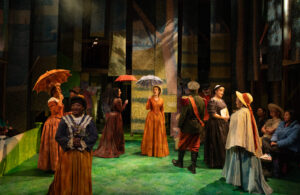
Birds happily chirping, tall trees climbing on all sides with hints of limbs hanging from above, a glimpsing view of a lake and its graceful boats, and everywhere from the ground up, rich and varied greens filling in the scene. As we enter what we expect to be the Shotgun Players arena we have come to know through the years, Scenic Designer Nina Ball has ensured we are welcomed into a serene, inviting “small suburban park, on an island in the river on an ordinary Sunday.”
Further, Sophia Craven’s exquisite lighting mastery creates a palette of light and shadow in streaks, patches, warming rays, and cooling corners that will shift as the unseen sun moves across the sky throughout the next two hours, thirty minutes as Shotgun Players presents a beautifully conceived, thoroughly engaging, emotionally captivating, and timely themed Sunday in the Park with George by Stephen Sondheim (music and lyrics) and James Lapine (book). Already in its third month of many sold-out audiences, so popular is the Susannah Martin-directed production that it is now in extension, running until February 15.
George-Pierre Seurat (1859-1891) was a post-Impressionist painter, famous today as the creator of the pointillist technique of painting where hundreds of thousands of multi-colored, dotted brush strokes blend at a distance into a picture full of rich hues, light, and shadows. During his too-short lifetime (dying at the age of 31), he was largely shunned by the established art community and never had a major exhibit.
The near-maniacal approach to his dotted painting, the adherence to a non-stop work ethic that precluded much time away from his sketchbook or canvas, and the obsession for perfection that meant minute attention to every detail of a model’s being are all magnificently captured in Sondheim’s music and lyrics in a song like “Color and Light.” As George stabs his brush as if piercing the canvas with a sharp tool, he sings in rapid progression, “More red, a little more red, blue, blue, blue, blue … There’s only color and light, yellow and white.”
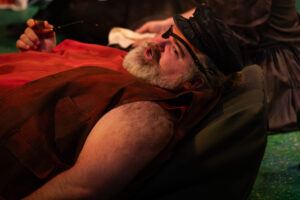
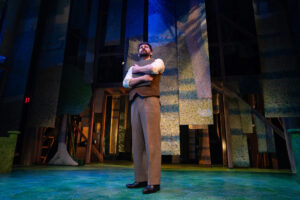 Kevin Singer captures George’s fanatically determined approach to art and life as he both sketches on the shores of the river and as he – in his darkened studio – pointedly attacks dot-by-dot a portion of a see-through canvas, facing us to provide us a first-hand view of his incredible intensity and near-maniacal desire for perfection. As he jabs more red and blue to produce purple, his voice brilliantly intones and mirrors with staccato exactness George’s concentrated and pointed method of applying his oils. His face is its own canvas of George’s unwavering attention to each and every dotted application. He clips off the Sondheim rush of lyrics with ease and yet with purpose, digging into the notes with a voice rich in zeal and intensity.
When George is sketching on a Sunday in the park amongst a bevy of lovers, soldiers, casual strollers, and even his mother and her nurse — all of whom will eventually make it onto his completed canvas — he at one point becomes two lazing dogs (Spot as a stand-up prop and Fifi as a sketch from his book) who yap and yep about their Sunday adventures and woes. Kevin Singer alternates delightfully between Spot’s back-of-throat, basso notes and Fifi’s falsetto yips as he becomes each dog, wallowing on the ground or sniffing in the grass, hilariously demonstrating their puppy antics.
Later in his studio, his George reflects with more sung gymnastics of voice punctuated by many, telling pauses as he self-exams how “you watch the rest of the world from a window” and about “how you feel when voices that come through the window go until they distance and die.” While he sings with some regret of the cost of his devotion to art, he concludes with a sense of satisfied justification “Look, I made a hat … where there was not a hat.” With his near-unwavering attention to his act of creating and his mostly ignoring all else around him, Kevin Singer is striking and memorable in his portrayal of a George Seurat who largely sacrificed everything else in his life in order to create art unlike any that had ever been created before.

And perhaps the greatest of his sacrifices is Dot, the woman who adores him even as she dislikes the hours of modeling in the hot sun in her heavy-material, midnight blue, bustle dress. As Marah Sotelo sings of “A trickle of sweat, the back of the head,” her Dot bemoans her “Sunday in the Park with George.” Singing with a wonderful edge in her vocals that can alternate between both exasperation with and admiration for George, she also rattles off Sondheim’s trademark rapidity of lyrics without one word being missed by us as audience.
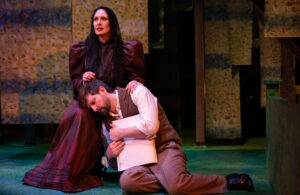
Her exuberant and sparkling personality along with her own desire to be seen and heard by the man she loves comes through in a myriad of expressions by Marah Sotelo’s Dot. Her passion that is heard in her beautifully reverberating notes is highlighted as Dot at one point strips in the park from her bustle and saunters seductively in her bloomers to the ever-busy, non-noticing George, singing with impressive resonance as she strokes his neck and shoots arrows from her darting eyes of both love and vexation. With each repeat of the word “George,” her mounting frustration becomes more evident.
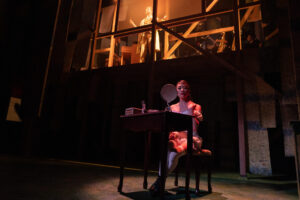
As Dot, Marah Sotelo is the evening’s standout star among a cast of thirteen who all prove to be quite exceptional. With time at the Follies being more to Dot’s liking than another night watching George try to get the right shade of black out of red, yellow, and blue, Dot matches his punching of paint dabs on his canvas with her own increasingly frantic patting on with a puff the make-up on her cheeks in front of an unseen mirror. Dot switches back-and-forth her mood of voice and manner as she weighs in song (“Everybody Loves Louie”) sticking with George or not.
Her alternative is the more boring, but also much more affectionate and attending Louis the baker (a jolly but silent Alex Rodriguez prancing-about-the-park offering sweets to all). When Dot does decide it is time finally to leave George, her “We Do Not Belong Together” is sung in heart-ripping notes expressing both her deep frustration and sadness.
While in the second act she becomes an old lady in wheelchair who is supposedly the daughter that Dot and George have before Dot leaves George to go to America with Louis, Marah Stotelo remarkably transforms into a ninety-eight-year-old Marie, grandmother of George Seurat’s great-grandson. Her singing voice is now that of an aged woman’s — slightly shaky but still full of telling clarity, vocals that again touch our hearts in “Children and Art.”
In this second act, the elderly Marie talks to her mother, Dot, now embedded behind her on the wall and forever in the famed, Seurat painting, A Sunday Afternoon on the Island of La Grande Jatte. Marie lovingly tells Dot about her grandson — also like his great-grandfather, an experimenting, controversial artist named George who is exhibiting a controversial Chromlolume #7 in celebration of the original’s famous painting. (The flashing, swirling, shape-changing device created by Props Designer Sydney Parcell is in itself a reason to grab a show ticket.)
This second George’s challenges as an avant-garde artist who must also worry about the business matters of pleasing money-generous patrons and foundations is the focus of Act Two. With a compelling voice and a frantic energy that exudes in his manners and vocals, Kevin Singer is once again exceptional in every regard as the great-grandson of the earlier George.
The parallels between the two Georges’ mannerisms and talents, their doubting critics, and their lost loves are the crowning touches in James Lapin’s book that combine with Stephen Sondheim’s astounding music and clever-beyond-words lyrics to make the musical such a favorite among many self-declared fanatics of the modern musical (including yours truly).
Along with the aforementioned talents of the two leads, eleven other actors fill the staged canvas of the first act and the modern art show of the second, ably playing characters often full of delightful quirk, spunk, and peculiarity. Jill Slyter is a somewhat grouchy Old Lady on the lake’s shore who is actually George’s mother, who bemoans all the changes around her and who urges George with emotionally tugging vocals to capture the scene of life around her before it (and perhaps she) fades away. No’eau Kahalekulu is her flirty and sometimes naughty nurse who also is particularly hilarious as a slow-drawling, Southern tourist (Mrs.) who hates everything about Paris except its delicious sweets. Her equally funny caricature of a 19th-century Southern husband is Kevin Rebultan, who is also captured on Seurat’s canvas as a German named Franz who is constantly arguing with his wife Frieda (Liz Curtis).
Along with his role as Louis the Baker, Alex Rodriguez is a rather pompous, full-of-false-airs artist named Jules who — along with his snobby, opinionated wife Yvonne (Laura Domingo) — sings despairing “ah’s” and “oh my’s” in “No Life” concerning how his friend George’s room-filling painting has “no presence.”
On the shaded shore of the lake are also a rough-mannered, complaint-spouting Boatman (Matt Standley) whose rich and deep vocals challenge George’s artistic perception in “The Day Off.” A debonair, full-voiced, and cutely courting Soldier (William Brosnahan) and his silent, wood-cut pal Soldier flirt heavily with their new-found girlfriends who reel them in while fishing at the shore. Celeste 1 (Lucy Swinson) and Celeste 2 (Antonia Reed) are a total hoot as two shrieky-voiced gossips who are first to notice that Dot and George are no longer a thing.
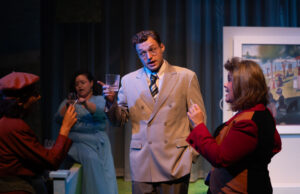
All of these often cartoonish sorts double in other, modern-day roles once the Act Two scene shifts to the second George’s exhibition — many in roles that are wonderful and telling juxtapositions to their Act 1 personas. Their personalities in both Acts are greatly enhanced and often made more humorous by the fabulous array of the two eras’ costumes designed by Madeline Berger.
But it is the closing of both acts when for me, Sunday in the Park with George pulls at my heartstrings and often causes some tears to form. As George’s guiding principles are repeated one word at a time (“Order,” “Design,” “Tension,” “Composition,” “Balance,” “Light”), the members of his most famous composition move into their forever-after positions — aided by the artist’s exacting adjustments of head, hem, or parasol. When he finally adds the word “Harmony,” Stephen Sondheim’s glorious “Sunday” sounds forth as a magnetic set of waves that draws us quietly toward an eventual climax of beautifully blended voices in a suddenly arresting volume,
“People strolling through the trees
Of a small suburban park
On an island in the river
On an ordinary Sunday.”
Rating: 5 E
A Theatre Eddys Best Bet Production
Sunday in the Park with George continues in an extended run through February 15, 2026, by Shotgun Players at their Ashby Stage, 1901 Ashby Avenue, Berkeley, California. Tickets are available online at https://shotgunplayers.org/box-office/, by phone at 510-841-6500, ext. 303, or by email at boxoffice@shotgunplayers.org.
Photo Credits: Robbie Sweeny
