
Hershey Felder: The Piano and Me
Hershey Felder, Book
Music by Mozart, Beethoven, Chopin, Rachmaninoff, Liszt, Bartók, Gershwin & More
TheatreWorks Silicon Valley
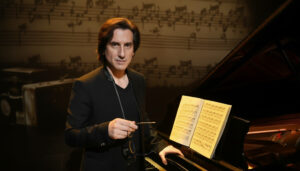
After creating and performing the past thirty years in some six thousand live performances and eighteen films the musical biographies of sixteen famed composers (Tchaikovsky, Chopin, Beethoven, Debussy, Gershwin, Berlin, and more), meticulous researcher, master storyteller, and world-renowned virtuoso Hershey Felder turns his attention to his own remarkable life story. On the stage where Felder has presented many regional and world premieres that have year after year broken the company’s former, box-office records, TheatreWorks Silicon Valley presents the world premiere of Hershey Felder: The Piano and Me — a music-infused, intimate sharing of his life-long, love relationship with the eighty-eight white and black keys along with the people who have enabled and supported his making of extraordinary art. The result is another must-see for Bay Area audiences by this man who clearly and deservedly has captured for many years their enduring adoration.
While Felder was born in Canada, the memoir that unfolds during the hour, forty-five-minute evening has the feel of a life story of an immigrant, of someone who often was seen as ‘different.’ Lucky to have both his mother’s Hungarian parents and his father’s Polish parents close by during his childhood — Holocaust survivors all — the young Hershey we first meet tells us about weekly visits to their houses where traditional foods steeped in Eastern European and Jewish flavors were always served. A little boy whom he describes as “fat and smelled like a pot of boiled cabbage” hears on the radio during one of those visits at the age of six the music of Liszt and is enthralled. A heavily-accented grandfather notices, and soon an upright piano arrives at his parents’ front door.
Almost immediately, all Hershey has to do is hear a recording of a piece like Mozart’s “Rondo Alla Truca” and he heads to the piano to feel his way through the awaiting keys in order soon to play the composition without the help of any sheet music. His first music teacher, Evelyn, helps him to realize that “music comes from the soul … from humanity,” not from just a page of printed notes.
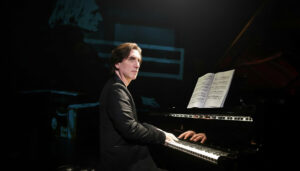
Of course, as the current Hershey Felder recounts these childhood memories of first meeting the likes of Bach, Chopin, and Beethoven — often by becoming in demeanor and accent the parents, relatives and teachers surrounding his younger years — he then heads to the Steinway on stage and mesmerizes us by playing Mozart’s “Rondo,” Beethoven’s “Fur Elise,” or a Chopin etude. Lucky for me that my seat in the Mountain View Center for the Performing Arts was on the left aisle where I had full view of fingers that time and again take a life on their own. At times, they become a line of gracefully dancing ballerinas sweeping back and forth across their black and white stage. When called upon to perform Bartók’s Hungarian folk-infused music, fingers become marching soldiers that parade with powerful steps and kicks. And when a thirteen-year-old is instructed to memorize in one week a Rachmaninoff piece, the tornadic fury of fingers moving so fast that they become a blur to watch is astounding.
I found myself transfixed watching the piano’s mirrored images of a boy’s, a teen’s, and a young man’s playing number and after number of the great composers’ master pieces while also totally enthralled witnessing the telling and often reenactment of the background stories and people attached to each.
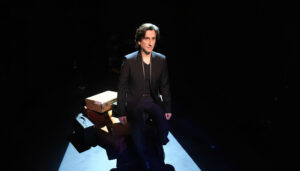
Particularly important and moving during the journey through Felder’s life are his repeated references to the stories of those who survived — and did not survive — the invasion of the Nazis during World War II. When young Hershey discovers a small suitcase packed with a kiddish cup, prayer shawl, and other precious items of his Jewish grandparents, he hears his Hungarian grandfather explain, “Because you never know when they will come to take us away.” Not yet understanding the meaning, he will later learn of a daughter — the sister of his usually silent Polish-heritage father — who “disappeared” in the 1940s when left behind as the rest of the family immigrated to Montreal. Bit by bit as the years pass, he hears of many more brothers and sisters of his grandparents who also “disappeared.”
This family history becomes a horrific but appropriate background for Felder in 1995 when he is recruited to go to Auschwitz for the 50th anniversary of the death camp’s liberation in order to record the stories of survivors for Stephen Spielberg’s Shoah project. The stories he tells us as well as the music he uses to accompany the people we meet are breathtakingly sad but also so important to hear — to help us remember what he heard others remember.
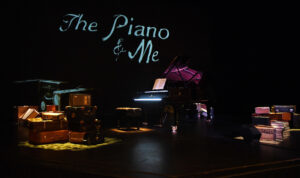 As has been true of other Hershey Felder stage productions, his chosen scenic and visual elements are few but are very powerful — in this case several stacks of vintage suitcases of all shapes and sizes, powerfully recalling his immigrant heritage as well as the stories of those forced from their homes and into Nazi camps. Stefano DeCarli once again enhances — often very poignantly — Felder’s recollections with projections and videos that provide settings to a particular story or faces — both famous and not — to a musical piece or a memory. Moods — joyous, funny, nostalgic, and sad — are rounded out in their creation by the lighting designs of Erik S. Barry.
A legitimate question might be raised as to why our hearing Hershey Felder’s live bio should matter and if this is not a bit of an ego trip for him. Although he is not himself an immigrant, his stories are so important to hear — especially now — when there is so much anti-immigrant noise coming at us from all directions. His stories remind us that there are life-saving reasons so many immigrants have reached our North American shores, and they reiterate what we should already know — immigrants have enriched our history and all aspects of of our lives, including very much the arts.
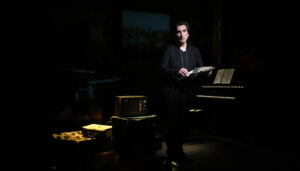
But what is most striking about Hershey Felder’s persona on stage and his overall presentation is his evident humble gratitude to those who provided him his suitcase for survival — his piano and its music — and his heartfelt appreciation to us, his faithful audiences over these past thirty years “who have allowed me to do what I do, to share stories, to share music.” I actually believe that any one who witnesses Hershey Felder: My Piano and Me will be the one who walks away full of gratitude for the opportunity to experience the life and music of this man who has truly become a Bay Area beloved treasure.
Rating: 5 E, MUST-SEE
Hershey Felder: My Piano and Me continues through February 8, 2026, as a world premiere by TheatreWorks Silicon Valley at the Mountain View Center for Performing Arts, 500 Castro Street, Mountain View California. Tickets are available online at www.theatreworks.org, by email at boxoffice@theatreworks.org, or by phone Tuesday – Sunday, noon to 6 p.m. at 1-877-662-TWSV (8978).
Photo Credit: David Lepori
