
Arab Spring
Denmo Ibrahim
Golden Thread Productions and San Francisco Bay Area Theatre Company
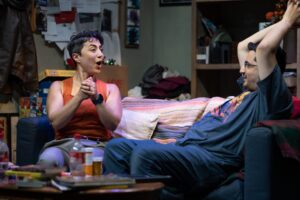
With fireworks occasionally exploding to mark the 4th of July in a Houston sweltering in 100+ degrees, a brother and sister who have not seen each other in five years arrive to bury in Muslim tradition a father she has not seen in twenty and one with whom he only recently reunited after his own long separation. As they enter a house overrun in an old man’s clutter and hosting in every corner and shelf hints of their own childhood memories — some good, many not — the siblings walk into a search of who really was the father they must now eulogize and who is this other person standing next to each that in many ways is a stranger that it is not yet clear how much either wants to know better. In her new play, Arab Spring — a comedy loaded with both bite and heart now in a power-packed world premiere co-production by Golden Thread Productions and San Francisco Bay Area Theatre Company — Denmo Ibrahim sends these siblings into a journey where they confront both myths and truths to help them discover who they really are as siblings and as individuals.

But those revelations will come only after a battlefield revolution within their father’s house that will sometimes vie with the one in 1776 in its skirmishes and attacks. Yusef is not about to let the older Dina who always bossed him around now tell him how to plan their father’s funeral, especially when she arrives saying she ‘wiki-ed’ how to do a Muslim funeral and admitting that she has never been to any funeral (although her twelve friends did give her advice, but mostly about their pets’ memorials). It takes only a few minutes before the two are once again warring kids, with Dina tackling Yusef from behind to keep him from answering a dead man’s phone, leading to the two rolling and punching on the floor, a big bite on his arm, and a hard noogie on her head.
As periodic truces bring calm to their sudden battles, the two sort begin sorting stacks of flung clothes and shoes, VHS tapes, take-out-food wrappings, and sundry other items that make it difficult to walk across the living room’s floor. Why their father had four coffee machines and four refrigerators full of food is only one of many mysteries they now come across, but a treasure of sorts is found in a box of cassettes. Popping one into a nearby player, suddenly they are both confronted by a young man’s voice back in Egypt talking about his job as a translator — the first of a number of CDs in which they begin to hear a voice somewhat familiar but also very different from the one they both knew of the man who abandoned the family after divorcing their mom.
As they sort a man’s lifetime into stacks of keep, throw away, sell, and give away, Dina and Yusef must also sort through their own sometimes troubled relationship. Moments of raised temper and pointed accusations send Dina into vacuuming with a vengeance or throwing in a fit sacks of collected stuff toward the brother who is trying to assert his ideas on her of how they should adhere to a Muslim tradition long ago abandoned. After all, to mitigate the anti-Arabic prejudice of neighbors’ who once firebombed their family’s car, Dina and Yusef grew up in a household their father insisted that they celebrate all holidays, including Christmas Eve and Easter. Why should Yusef now suddenly insist they welcome into their father’s house people from the mosque neither attends after a funeral that he says Dina cannot attend because she is a woman?
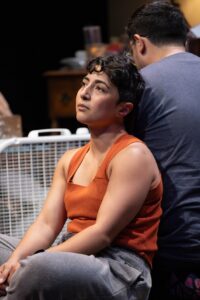
Both Arti Ishak and Salim Razawi are arrestingly stunning in their roles as Dina and Yusef, respectively. Salim Razawi’s Dina is at times almost statuesque in their portrayal of a sister who is unbending in letting go of years of pent-up resentment of a father who once rejected his daughter’s sexual orientation and thus in traditional Muslim fashion, turned away from his daughter in totality. Dina also carries hard feelings that come to the open in explosions mirroring the fireworks heard and seen from the Houston skies about a brother she sees as always favored unfairly just because he is the older male of the family.
But at the same time, Dina show increasing signs of melting that hard exterior as more cassettes play of a younger father before she knew him, as she succumbs to her brother’s invitation to dance the dance she never got to do at her prom, and especially as she listens to her own voice as a father praises his four-year-old daughter after the first day in kindergarten — the last a beautifully moving scene long to stay in audience memories.
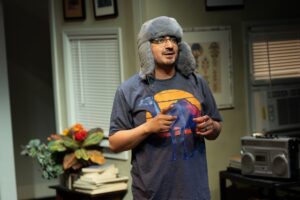
When we first meet Yusef staring outside his father’s house with the fear in his eyes of a deer in headlights, he is wearing a furry winter cap with ear muffs — his comfort hat — even in Texas temps rivaling hell itself. He is also chanting a set of affirmations, ending with with multiple repeats of “I am a strong and capable man” while chewing gum to calm his stress. After all, there stands the estranged sister he did not expect to show up, and inside the closed door is a history he is not sure he is ready to face nor a burial he is ready to plan.
Salim Razawi’s Yusef is easy immediately to like, a bit of a teddy bear and kid mixture who decides that they need to decorate the house for the next day’s gathering with crepe paper bunting, black of course. A father himself of two young boys, he tells childless Dina, “Having kids helps you understand your own parents;” yet it later hits him that there are now many questions he has about his dad, including, “Who was he?”
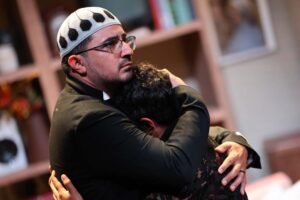
With an eye to letting each moment emerge as if spontaneously happening for the first time, Nailah Unole Didanas’ea Harper-Malveaux directs these two accomplished actors with humor and heart, with edge and exactness, with furious pace and well-placed pause. Set within a dead man’s den of collected treasures, accumulated rubble, and stacks of smelly trash, Arab Spring also provides scenic designer Mikiko Uesugi and props designer Heidi Button a heyday of opportunities to display their artistic and creative skills, which both have done to the max.
Three vintage, small-screen TVs spring to life from time to time to show home videos of the memories being recalled via cassette recordings or siblings’ memories, the videos and the set’s lighting designed by Sinjin Jones. The sounds of outside celebrations as well as various well-timed beeps and rings are just some of the work of designer Michael Kelly. The contrasting and sometimes conflicting differences in personality of the siblings is evident in many ways, including in the design of what they wear by Buffy Yahyaa.
Khaled Abol Naga voices with intent and insight both the young and the elderly Samir, the unseen but very present deceased father, while Marlo LaRosee is the voice of a high-voiced, excited, and quite impressive four-year-old Dina.
As Yusef and Dina go on this search for truth of a past that both siblings have often tried to forget, they find themselves also hunting for forgiveness of a father, of a sibling, and even of themselves. Coming along with them in their pursuit that is often like walking through a battlefield of hidden mines is a privilege Denmo Ibrahim provides us in her tense yet funny, harsh yet comforting Arab Spring. The co-production by Golden Thread and SFBATCO is nothing short of a must-see in a world premiere that hopefully will have a long life on stages coast-to-coast.
Rating: 5-E, MUST-SEE
A Theatre Eddys Best Bet Production
Arab Spring continues through July 12, 2026 in a world premiere co-production by Golden Thread Productions and San Francisco Bay Area Theatre Company at Potrero Stage, 1695 18th Street, San Francisco, CA. Tickets are available at https://www.sfbatco.org/ and at https://goldenthread.org/.
Photo Credits: Jared Randolph
